Terria | What if your visitors stayed one more day?
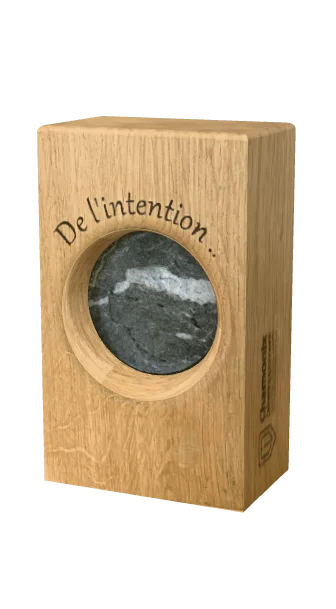
- Pitch competition · Winner
This week, I had the chance to take part in my first pitch competition, and to land my first win! 🥇
The competition took place in Chamonix, in front of the founding members of the USMB Foundation. The event was organized by SAEM Chamonix Développement, as part of an entrepreneurship bootcamp focused on innovation in the region.
For the occasion, I pitched an AI solution for tourism, built around a concrete challenge: getting visitors to stay longer.
The project relies on a decision-making AI that can suggest personalized trip itineraries, aligned with the town's goals.
At the end of the itinerary, one key question pops up:
👉 “What if you stayed one more day?”
The visitor is then offered a program for an extra day, so they can picture what they would miss by leaving too soon.
Over the three days of the bootcamp (between workshops, conversations and meetings), the idea was refined and challenged, all the way to the pitch competition. 💡
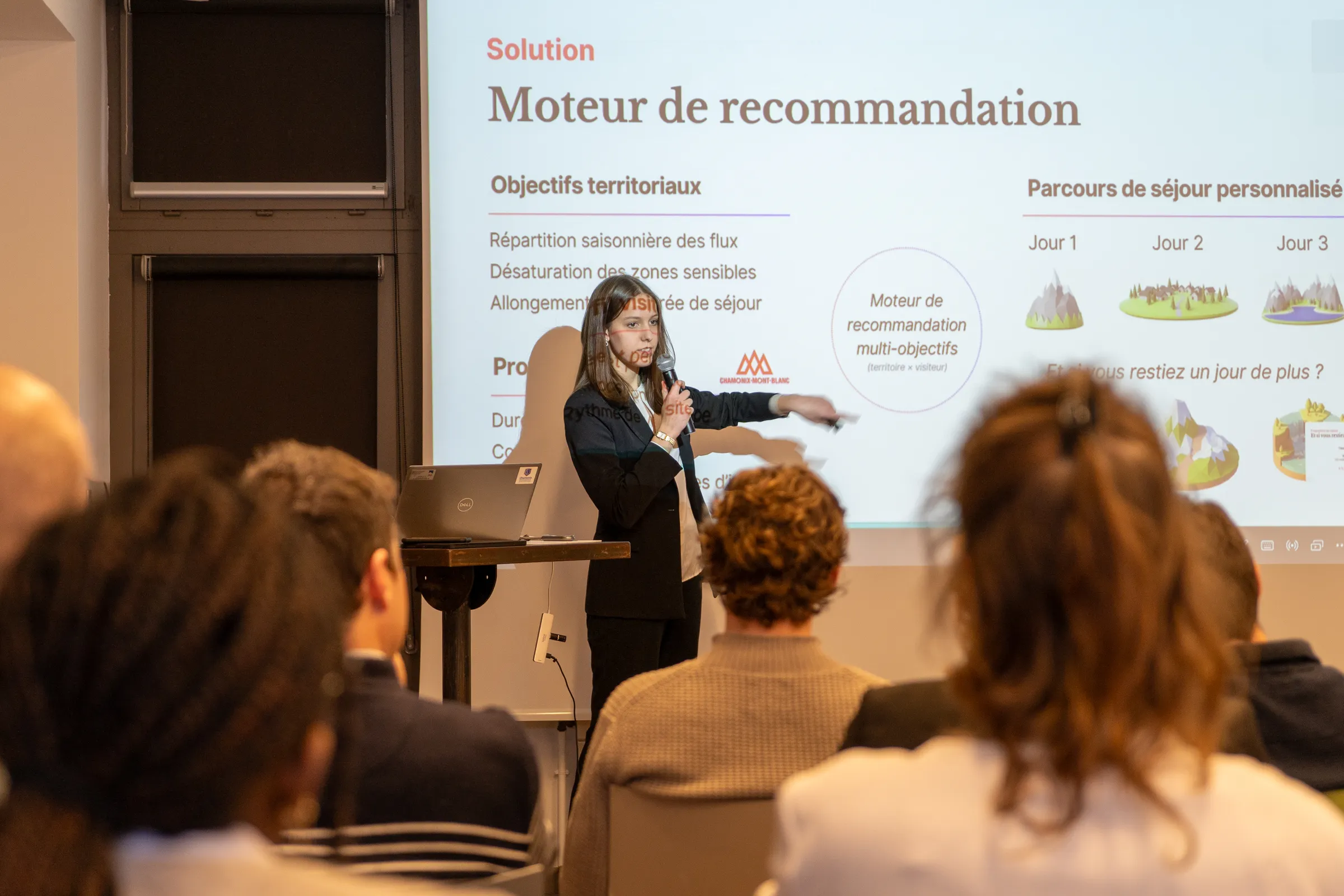
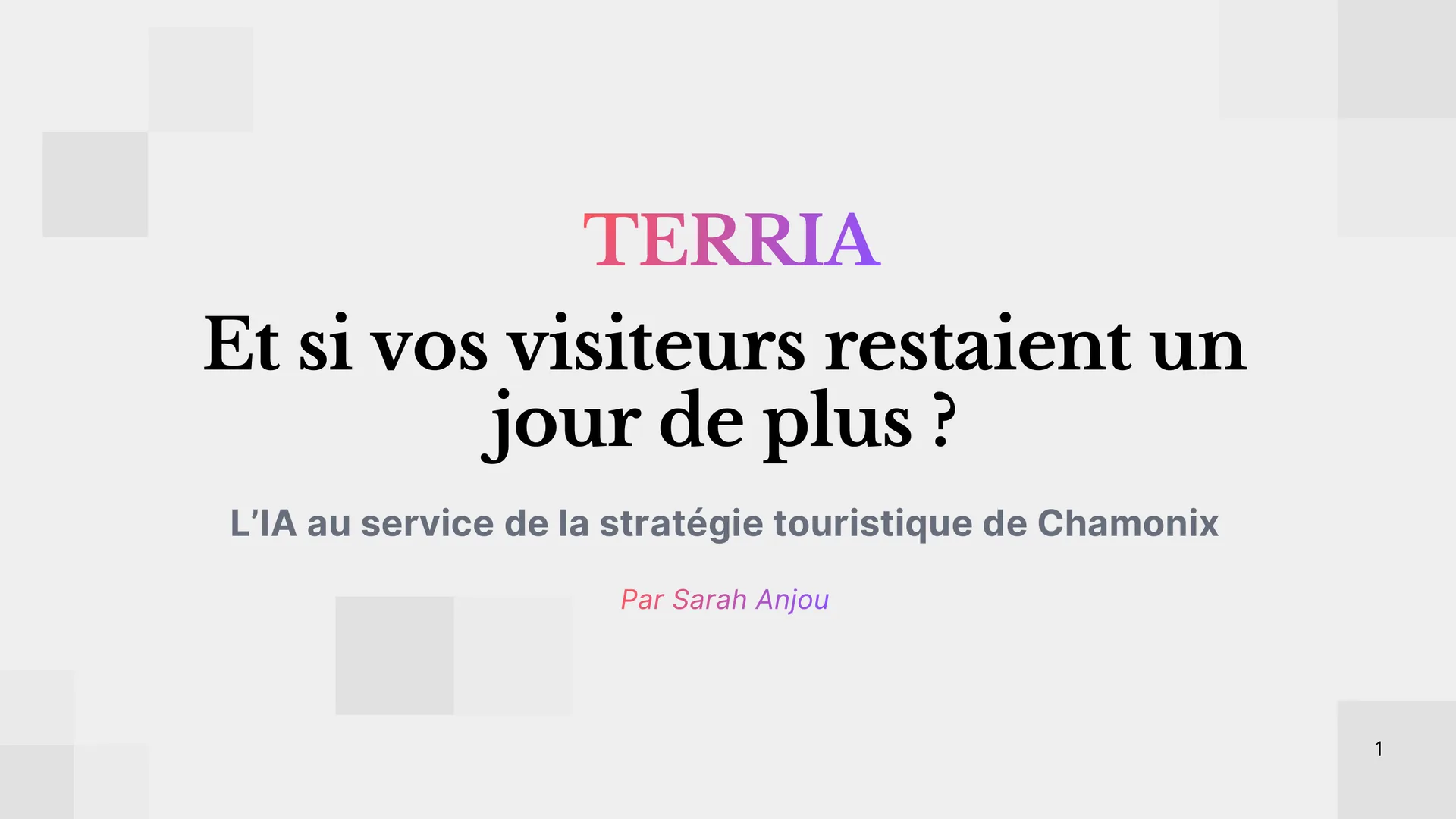
Hello everyone, my name is Sarah Anjou and I'm here to present Terria, an artificial intelligence project serving Chamonix's tourism strategy.
Today, we're going to ask ourselves one very simple question: what if your visitors stayed one more day?
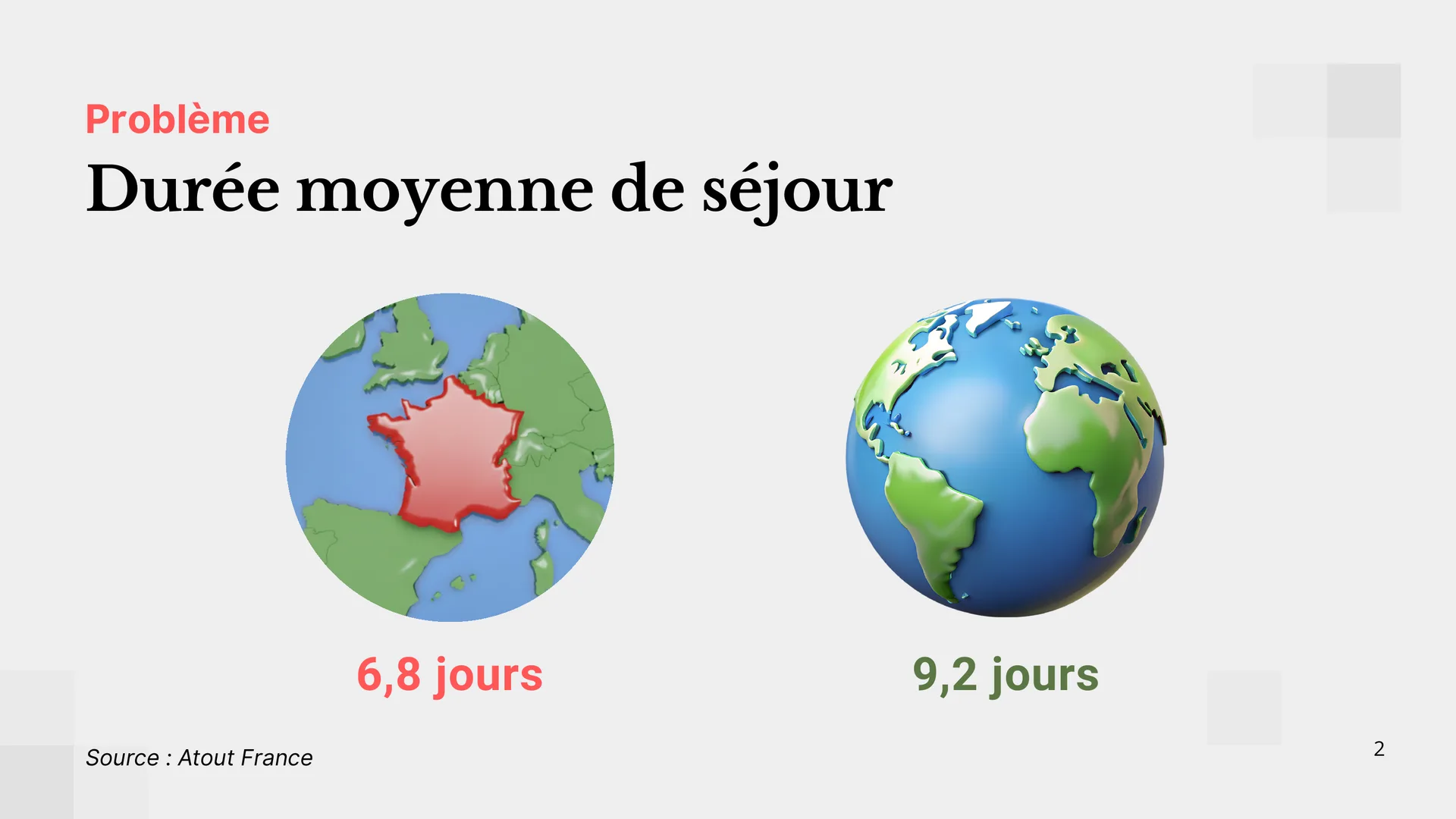
According to the Atout France figures used in this presentation, the average length of stay is 6.8 days in France, versus 9.2 days internationally. That 2.4-day gap makes length of stay a lever worth exploring for French destinations.
For a place like Chamonix, the challenge is to figure out what could give visitors a reason to stay longer. Extending a stay means they need to be able to stay longer, and to see the point of spending an extra day here.
When those conditions are met, longer stays can bring real economic benefits to the region. To gauge the potential, let's look at what this gap would represent across France.
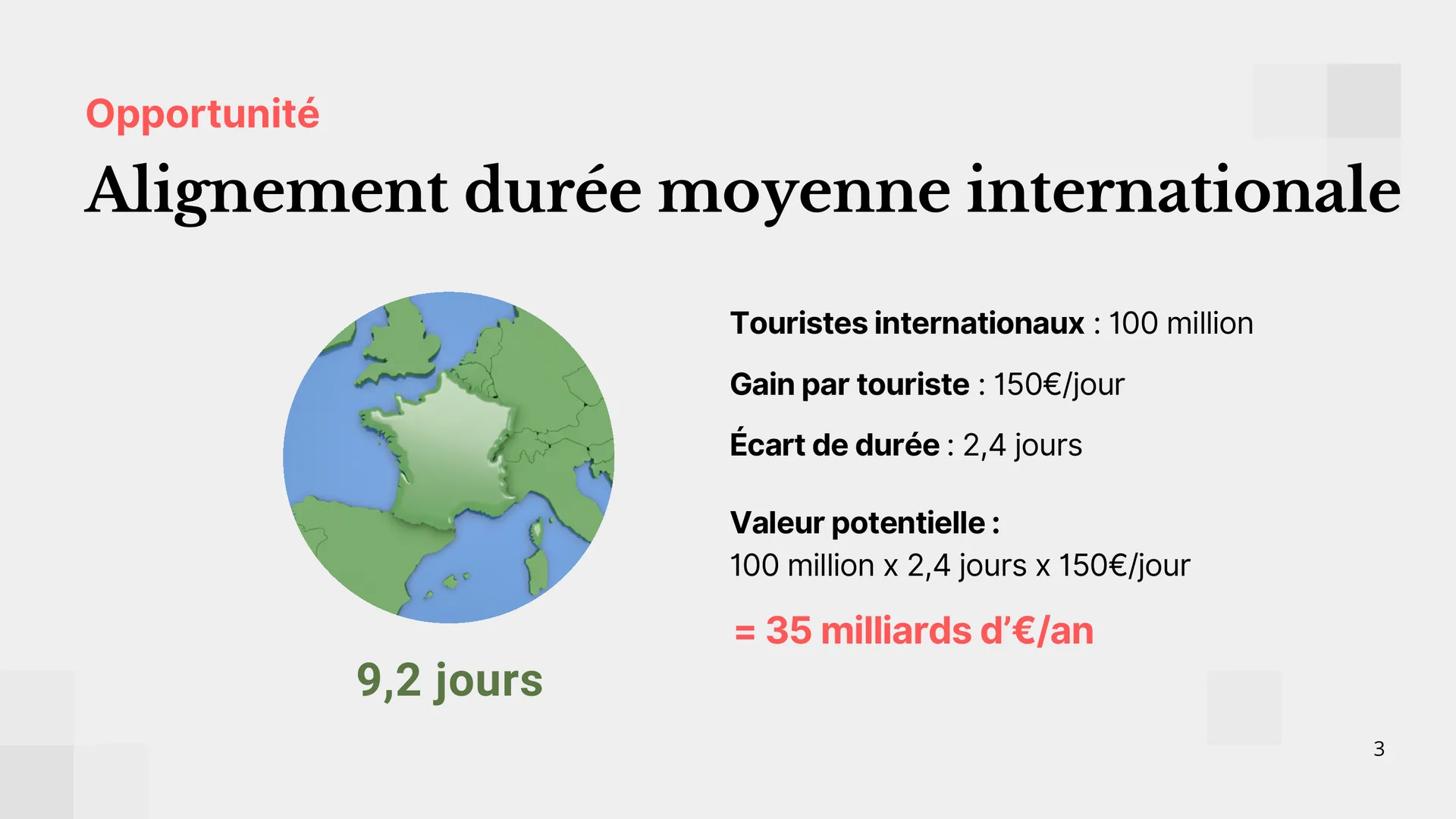
To grasp the economic stakes, we can run a simple calculation at the scale of France.
With the assumptions on this slide (100 million international tourists, €150 spent per day and a 2.4-day gap in length of stay), we get a potential of several tens of billions of euros per year, around €35 to 36 billion.
This is a theoretical scenario, meant to give an order of magnitude.
What interests me in this calculation is the lever it reveals: part of tourism's value can come from the extra time spent on site.
And that lever becomes much more concrete when you look at it at the scale of the Chamonix valley.
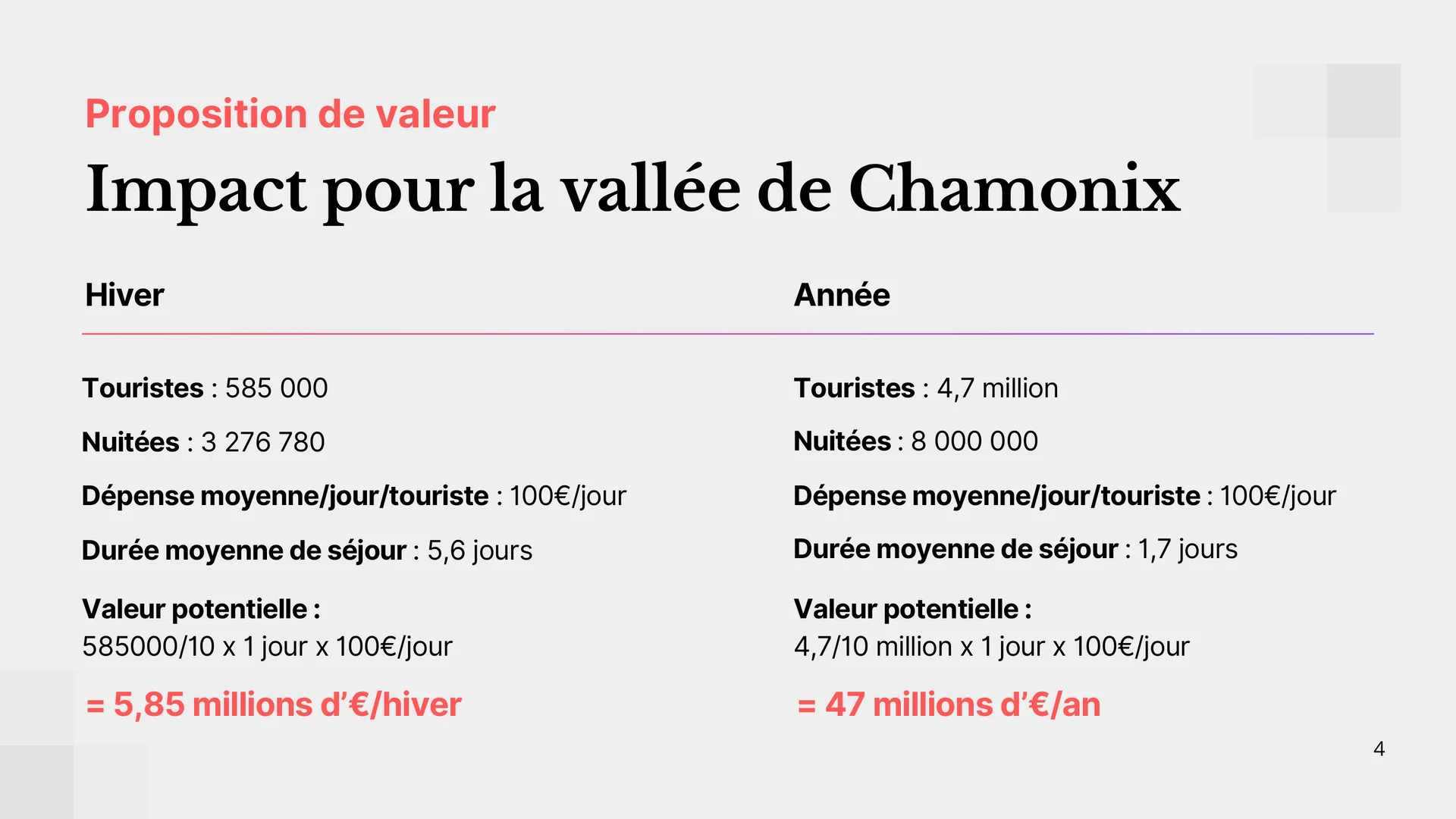
Let's take a very simple assumption: one visitor in ten decides to stay one extra day, spending an average of €100 that day.
Based on the 585,000 tourists reported for the winter, that would mean €5.85 million in additional spending in the valley.
Applying the same scenario to the 4.7 million visitors reported over the year, we reach €47 million.
These amounts represent potential benefits for the whole area: accommodation, restaurants, shops, activities and other services.
Fieldwork will tell us how many visitors actually extend their stay. Just keep this order of magnitude in mind: one visitor in ten, a single extra day, and millions of euros stay in the valley.
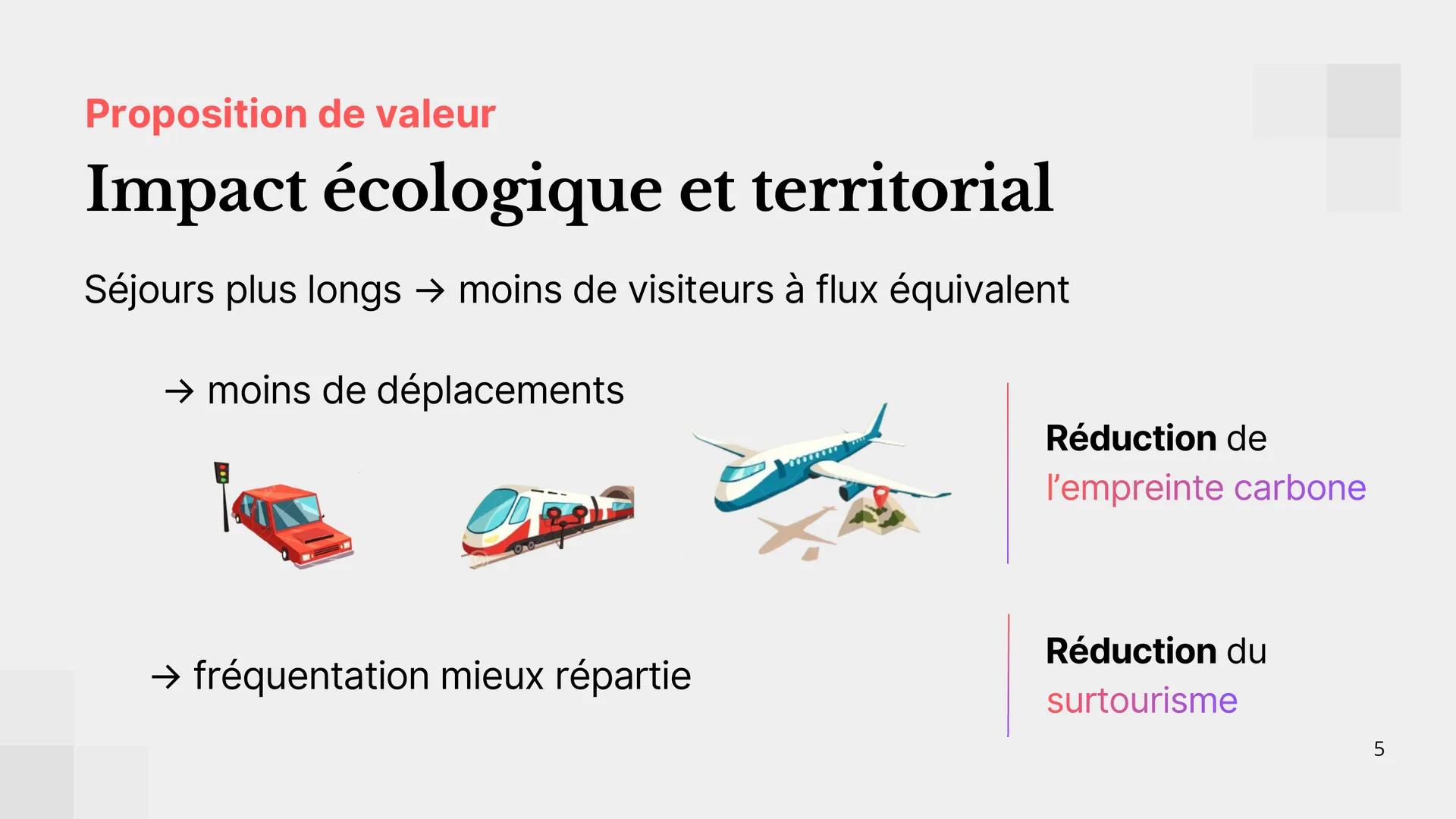
The project also matters for the environment and the region.
For the same number of overnight stays, longer stays mean welcoming fewer successive visitors. That can cut the number of arrival and departure trips, and with them the carbon footprint of all that travel.
The other challenge is how visitors are spread out.
When lots of visitors crowd the same places at the same times, some areas come under heavy pressure. By taking the valley's goals into account, Terria could suggest itineraries that also showcase other areas and other times of year.
The extra day would therefore pay off twice: a richer experience for the visitor, and better-distributed visitor flows.
This link between the visitor experience and the region's strategy is what drives the project.
For this to work, the extra day has to feel desirable and concrete.
When someone plans three days in Chamonix, simply telling them “stay longer” isn't enough. You have to show them what they could experience that day, and why it matches what they're looking for.
That's what I want to build with Terria: turning an abstract possibility into a program visitors can picture themselves in.
Before showing you how, let me quickly introduce the experience I'm drawing on to build this project.
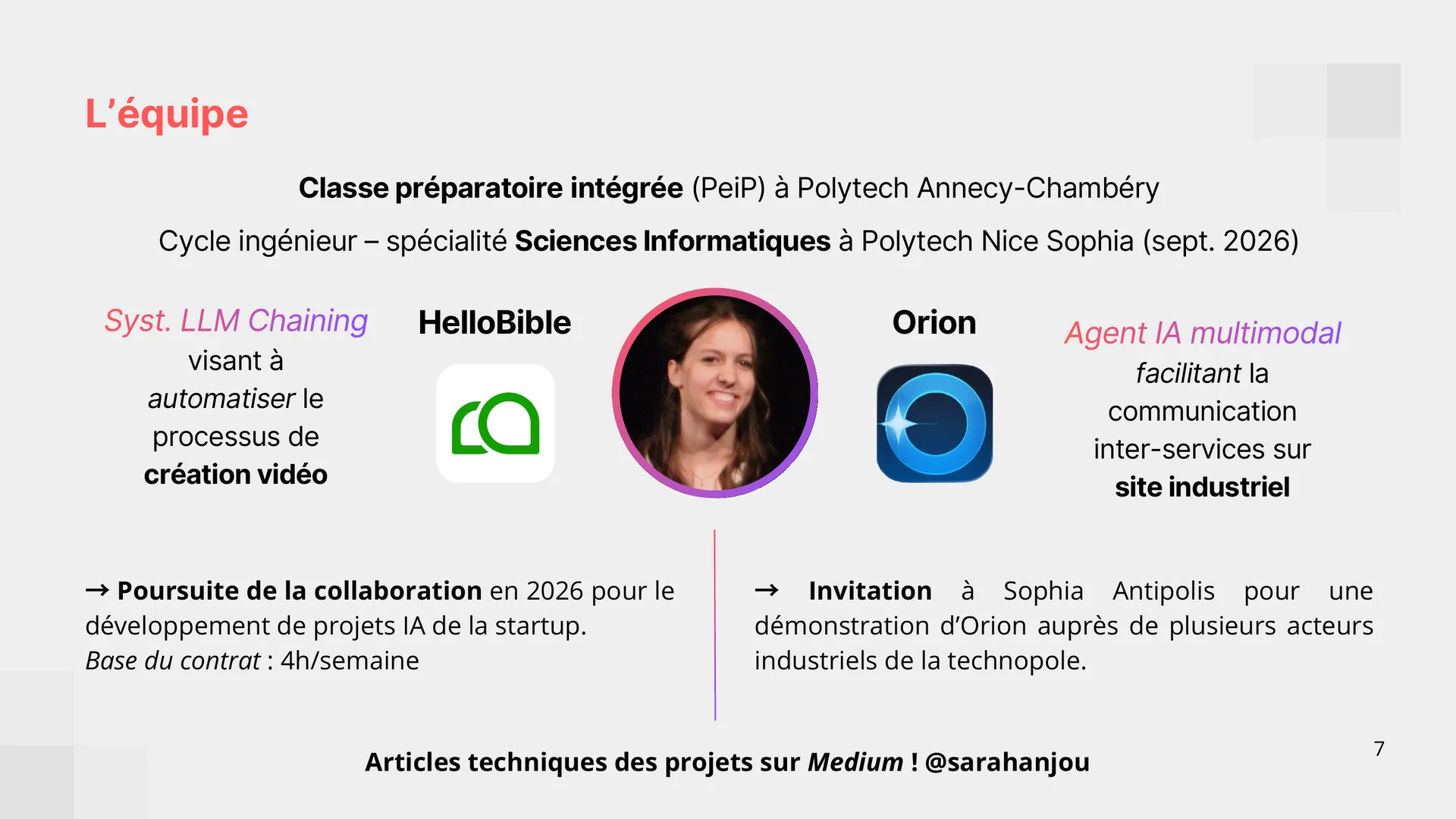
I'm currently in the integrated preparatory program at Polytech Annecy-Chambéry, and I plan to continue into the engineering program in Computer Science at Polytech Nice Sophia in September 2026.
Alongside my studies, I work with various companies on artificial intelligence projects.
I started this work with HelloBible, setting up an LLM chaining system to automate their video creation process. That collaboration continues in 2026.
I also built Orion, a multimodal AI agent designed to make communication easier between departments at an industrial site.
These experiences taught me to start from a need, build a technical solution, and think about how it will actually be used.
With Terria, I want to bring that same approach to tourism, drawing as well on the knowledge and feedback of local stakeholders.
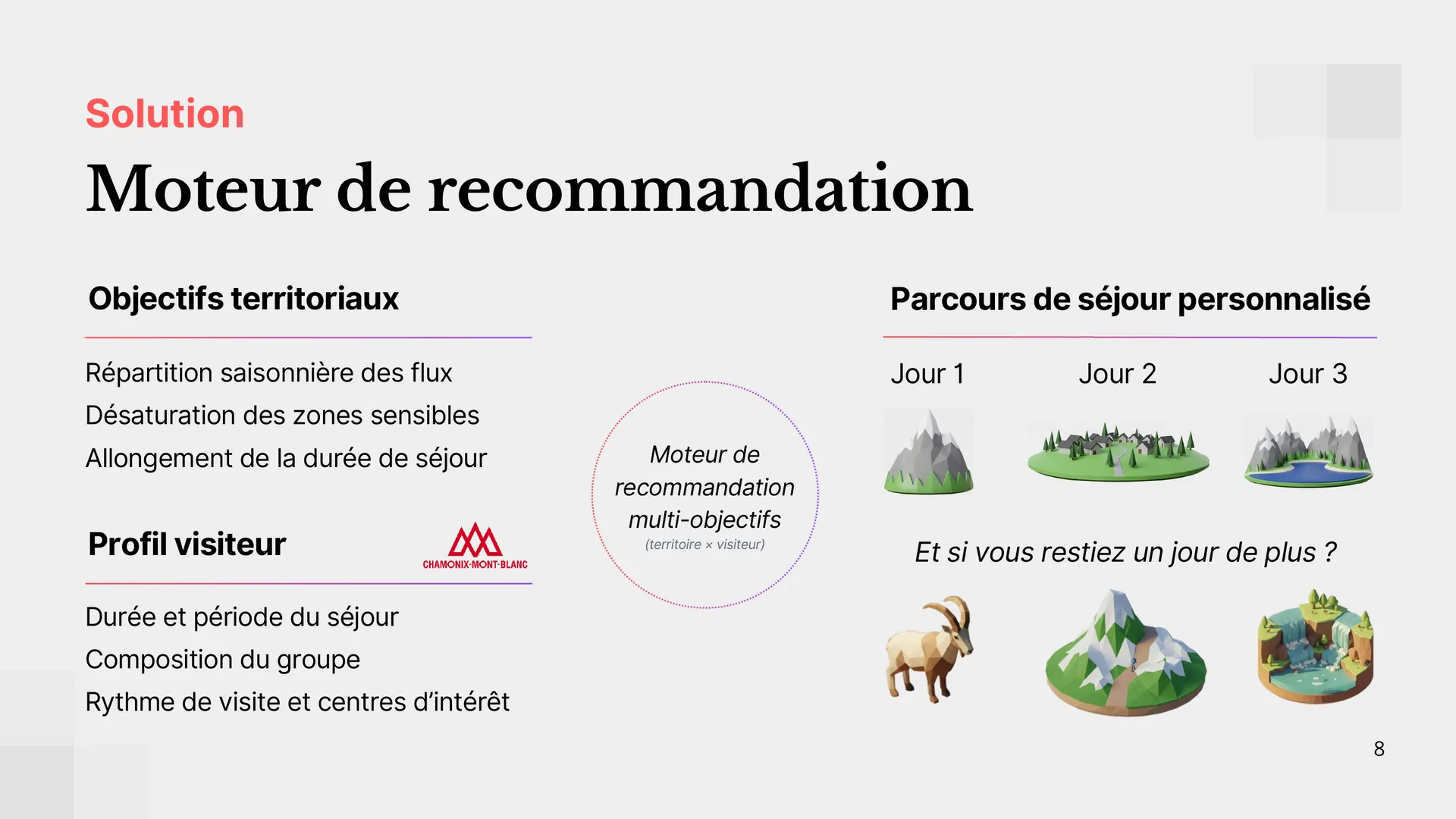
Terria is built on a recommendation engine that combines two sets of information.
On one side, the region's goals: spreading visitor flows better across the year, easing pressure on certain areas, and lengthening stays.
On the other, the visitor's profile: when are they coming, for how long, with whom, at what pace do they want to discover the valley, and what are they interested in?
From this information and the available offerings, the engine suggests a personalized trip itinerary.
Take a family planning a three-day visit. The program has to account for the children's ages, the pace they want and the activities they enjoy. It also has to stay consistent with the region's priorities.
Once those three days are laid out, Terria asks the key question: “What if you stayed one more day?”
The visitor then discovers a fourth day, also tailored to their profile. For example, a walk the whole group can manage and the discovery of an area they hadn't planned to visit.
They can then see what they would miss by leaving too soon.
That one extra day is the whole value of Terria: where what the visitor would love to experience meets what the region wants to encourage.
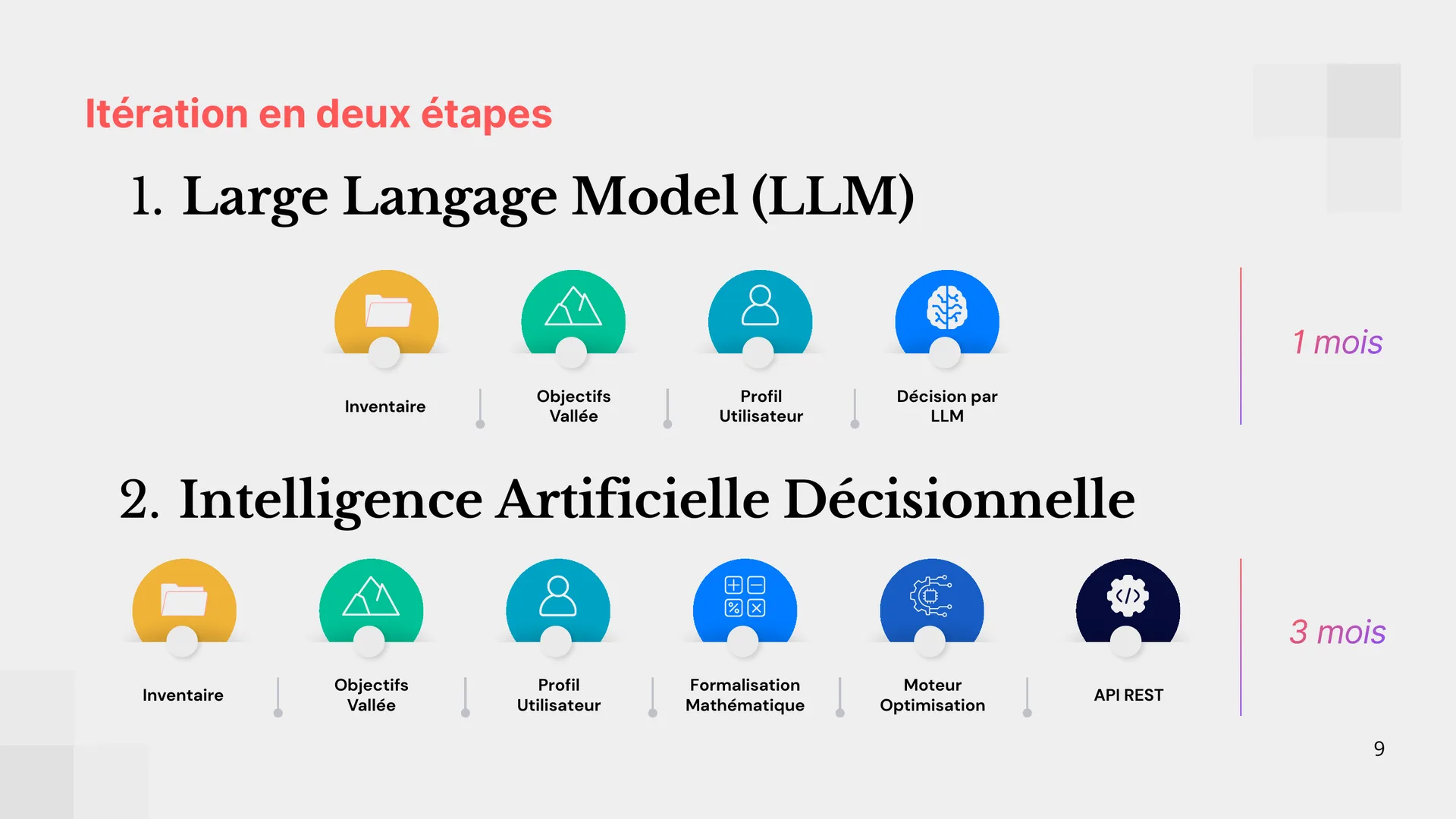
To build this solution, I'm proposing a two-step approach.
The first step is a prototype built on a large language model, an LLM, over roughly one month.
We feed it the inventory of activities, the valley's goals and the visitor's profile, so it produces a first trip proposal. This lets us test the experience quickly: is the program relevant? Does the extra day make people want to stay?
The second step, shown here over a three-month horizon, is to build the decision-making AI engine.
The information is then translated into rules and mathematical criteria. An optimization engine searches for an itinerary that respects the constraints and balances the different goals.
The REST API planned at this stage would make the engine available to other digital tools.
This progression lets us test real usage first, then build a system whose choices we can control much more closely.
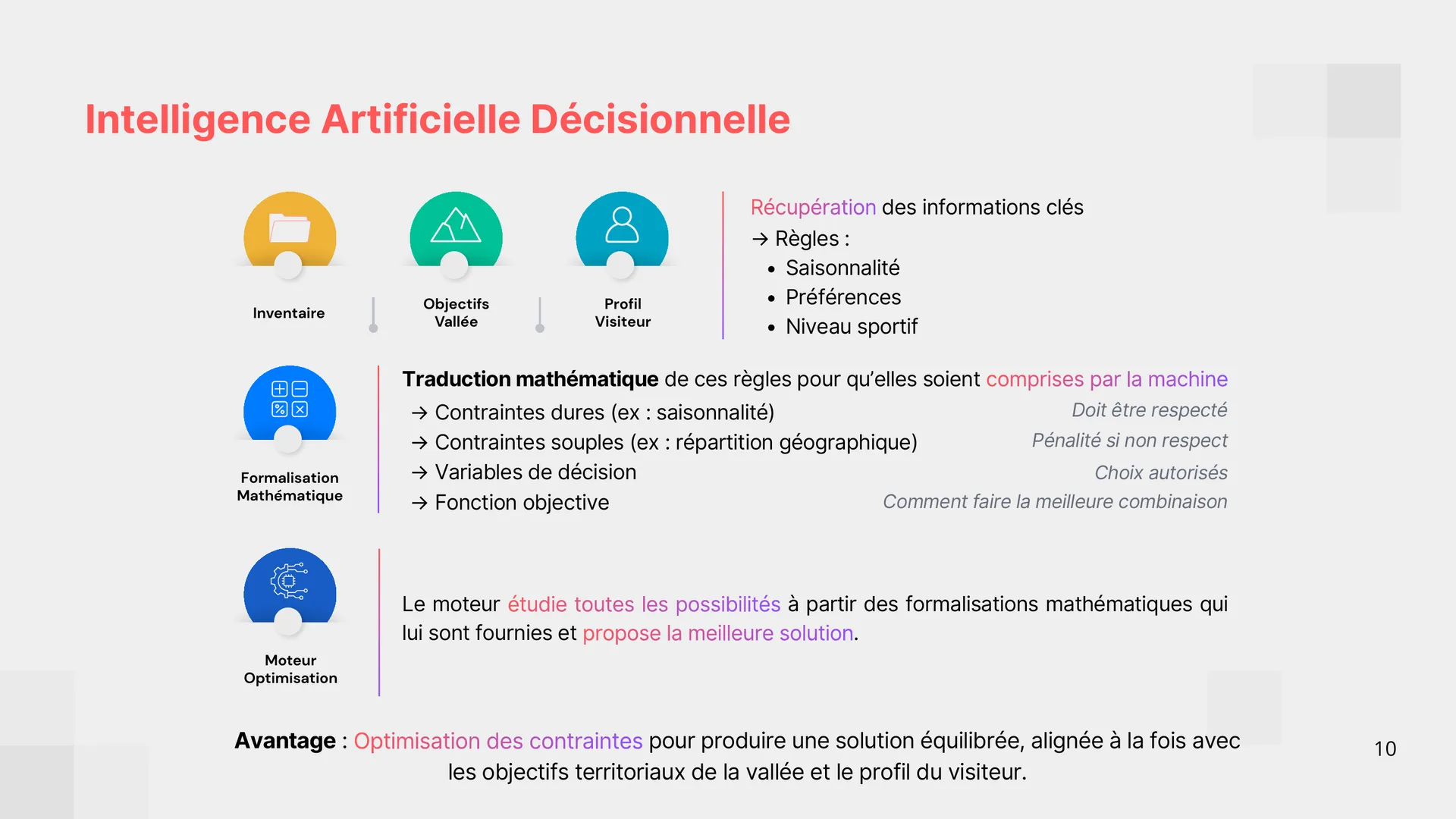
In practice, the engine starts from the available activities, the valley's goals and the visitor's profile, and derives rules from them.
Some are hard constraints: an activity that's unavailable during the stay, or too demanding for the group, is ruled out. Others are soft constraints: spreading visits more evenly across the valley's areas, with a penalty if not.
The decision variables are the chosen activities and where they fit in the stay. The objective function balances visitor satisfaction against the region's priorities.
The optimization engine then looks for the best combination. Every itinerary becomes an explicit trade-off between what the visitor wants, what's actually possible, and what's at stake for the valley.
That's how Terria puts artificial intelligence to work for the valley's goals, while giving every visitor a stay that feels like their own. And, maybe, one more day.
Thank you for listening.
Thanks
A huge thank you to Kyla MacLean, Francois Thauvin and Evan Malry for welcoming us and giving us the chance to live such an experience, and to the participants I shared this adventure with: Jacques Charroy, Valentin Rollant and Gabriel Carro.
Thanks to the local stakeholders (Cedric Piatek, Hervé Villard and Pauline Monnin) and to Frédéric Khadri for their valuable advice.
Thanks as well to Mountain Path for the introduction to ice climbing on a frozen waterfall, a powerful experience about leadership and soft skills.
And finally, thank you to the jury members for their feedback and the rich discussions after the competition. 🙏